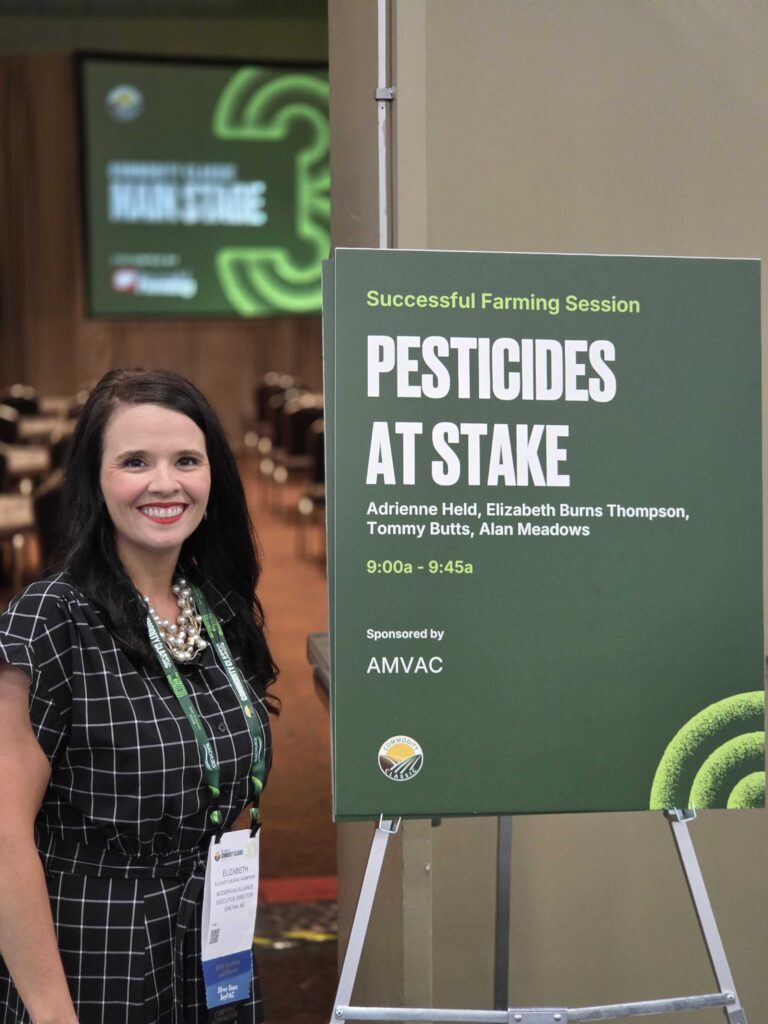
Commodity Classic Panel Puts Pesticides Center Stage
At this year’s Commodity Classic, Modern Ag Alliance Executive Director Elizabeth Burns-Thompson took to the Main Stage to share insights into ongoing regulatory debates surrounding crop protection tools like pesticides during the Pesticides at Stake panel. Joining fellow panelists Tommy Butts, Extension Weed Scientist at Purdue University, and Alan Meadows, a Tennessee farmer and director with the American Soybean Association, the conversation explored what these developments mean for farmers in the field and why regulatory clarity is essential to protecting their continued access to proven tools.
Below are key highlights from Elizabeth’s remarks.
What pesticide litigation means for farmers
At the heart of the current litigation is a dispute over labeling. In courtrooms across the country, juries have been asked to decide whether pesticide manufacturers should include warnings beyond those approved by the Environmental Protection Agency (EPA). Under federal law, however, the EPA is responsible for conducting comprehensive scientific reviews of pesticides and determining what health and safety information belongs on a product’s label.
Despite this rigorous process, some courtroom verdicts have concluded that additional warnings are warranted, even when the EPA’s scientific assessments do not support them. This dynamic creates an untenable situation for manufacturers: they are required by law to follow the EPA-approved label, yet face liability for doing exactly that. What began as litigation targeting a single active ingredient has evolved into a multi-billion-dollar test case with broader implications for the future availability of many crop protection tools.
Why policymakers are stepping up for farmers
In response to the growing instability around how pesticide labels are interpreted in court, several states, including North Dakota and Georgia, passed legislation in 2025 reaffirming that EPA-approved labels satisfy health and safety warning requirements. In 2026, similar legislation is under consideration in additional states. At the federal level, early drafts of the Farm Bill include language reinforcing that the EPA-approved label is the law. Recent executive actions have also highlighted the importance of maintaining access to critical agricultural inputs to support U.S. food security and national security.
From the Modern Ag Alliance’s perspective, a durable solution must focus on ensuring regulatory clarity and consistency—not on any single product. If the authority of EPA-approved labels is not reaffirmed, farmers could see this same cycle repeated across other chemistries and technologies.
For farmers, the scale of this litigation should serve as both a wake-up call and a call to action.
Recommendations for farmers to help move policy forward
Farmers play a critical role in shaping these conversations. There are persistent misconceptions about modern agriculture and the safety of crop protection products. If farmers don’t tell their story, others will define it for them.
Lawmakers cannot be expected to fully understand agriculture without hearing directly from those who live it every day. Farmers are encouraged to reach out to their state and federal representatives, explain how crop protection tools fit into their operations, and describe what’s at stake for their families and communities.
Correcting misinformation and clearly articulating why these tools matter—to yields, to conservation practices, and to food affordability—will be essential to ensuring that science-based policies continue to guide decisions in the months ahead.