
Editorial boards highlight the need for certainty for farmers
From The Washington Post to The Wall Street Journal the consensus is clear.
When major editorial boards from across the political spectrum weigh in on an issue affecting American agriculture, it matters.
Recent opinion pieces from The Washington Post and The Wall Street Journal underscores the importance of science-based regulation, the growing influence of the litigation industry, and the need for long-term certainty for farmers who rely on crop protection tools.
The Washington Post: We need legislative action
In a recent editorial, The Washington Post addressed the recent executive order declaring glyphosate an essential for national security.
The Post highlighted the administration’s national security rationale and the concern of foreign interference on the industry. Without domestic production of glyphosate, U.S. farmers would have to rely entirely on other countries for the chemical and could lead to shortages.
![A quote from the Washington Post Editorial Board appears over a field: The administration says securing the supply chain of glyphosate [...] is essential to national defense because much of the nation’s food production relies on it.](https://modernagalliance.org/wp-content/uploads/2026/03/MAA_Social_X_MessageName_MMDDYYYY_1600x900-1024x576.png)
The Post also reaffirmed the need for a legislative solution to the continued cycle of uncertainty around pesticide labeling regulation, beyond the executive order or other court decisions.
![A quote from the Washington Post Editorial Board over a field background reads: “There’s an option superior to relying on courts or executive orders: Congress [...] Finding a way to pass a law is a better bet in the long run.”.](https://modernagalliance.org/wp-content/uploads/2026/03/MAA_Social_X_MessageName_MMDDYYYY_1600x900-1-1-1024x576.png)
The Wall Street Journal: Follow the science, not misguided litigation
The Wall Street Journal editorial board has also been a consistent voice on this issue.
In one editorial, the board spotlighted the financial incentives driving the litigation industry’s attacks on American agriculture. They noted the impacts of frivolous litigation, writing:
![A quote on a field background reads: “Costs of defending against litigation get passed along to workers, consumers and shareholders [...] Excessive litigation is a tax on everyday Americans.” — Wall Street Journal Editorial Board.](https://modernagalliance.org/wp-content/uploads/2026/03/MAA_Social_X_MessageName_MMDDYYYY_1600x900-2-1024x576.png)
In another editorial, The Journal addressed glyphosate’s safety record directly in response to the EPA’s letter about California’s Proposition 65. Prop 65 would have created conflicting state level labelling requirements on products they deem carcinogenic, including glyphosate, despite the EPA having sole authority over pesticide labelling requirements.
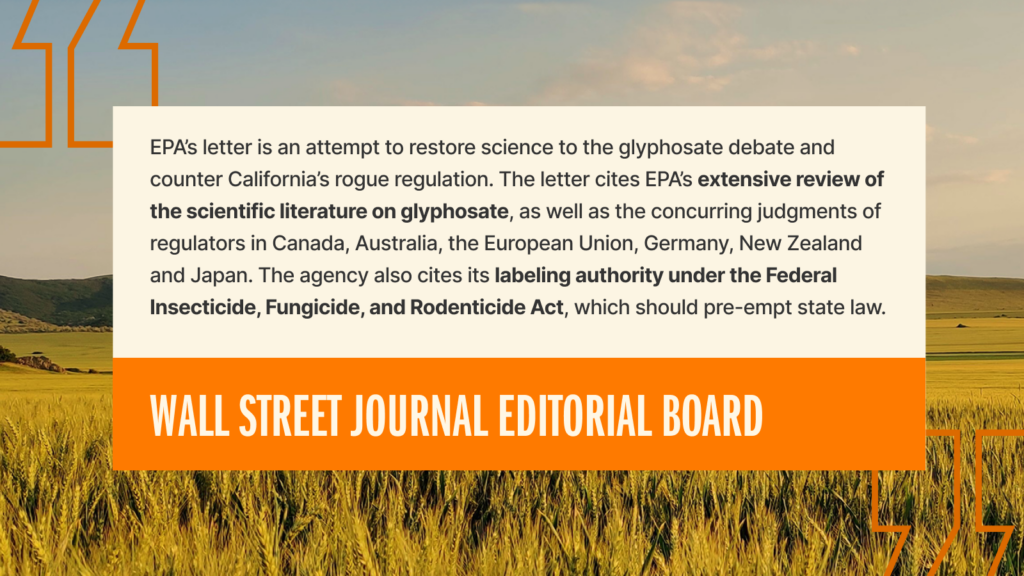
Taken together, these editorials reinforce two essential truths: glyphosate’s safety has been repeatedly affirmed by regulators around the world, and excessive litigation ultimately raises costs for farmers, businesses, and American families.
Why This Matters for Farmers
Credible news outlets have acknowledged the scientific consensus around glyphosate and the necessity of the tool, and policymakers should take notice.
Farmers depend on glyphosate to control weeds, maintain yields, and implement conservation practices like no-till and cover crops. They also depend on consistent, science-based labeling rules that allow them to plan for the future with certainty.
The debate should not be driven by frivolous lawsuits or a patchwork of conflicting state requirements. It should be grounded in the rigorous review process already conducted by the EPA and supported by health authorities around the world.
The importance of these editorials is clear: across ideological lines, leading national voices are recognizing that science must guide policy decisions affecting American agriculture and our food, fuel, and fiber supply.